One to Watch
 Olesia Zyppelt and the Stillness Inside Motion
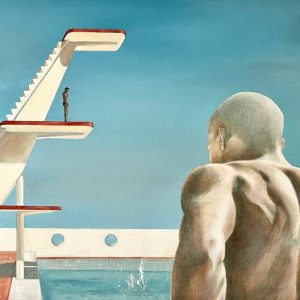
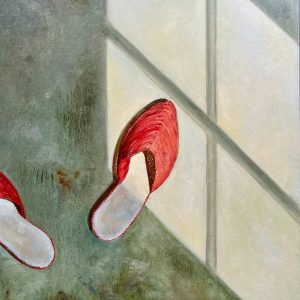
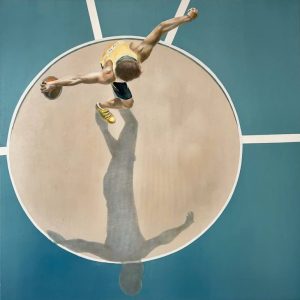
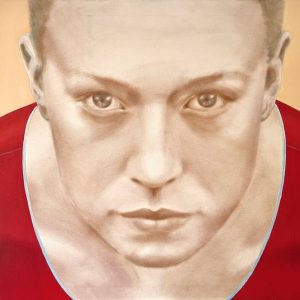
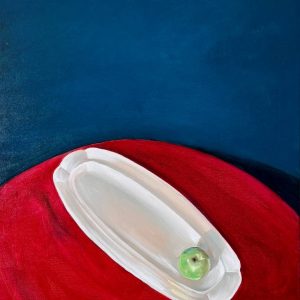
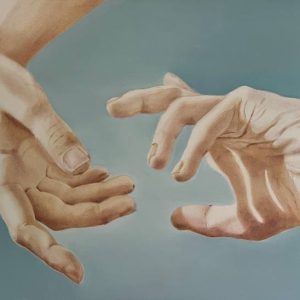
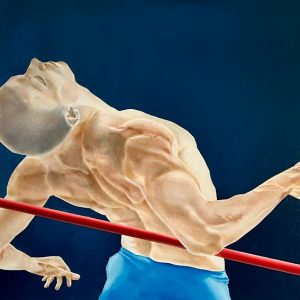
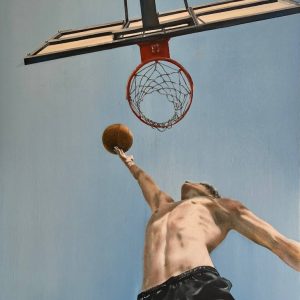
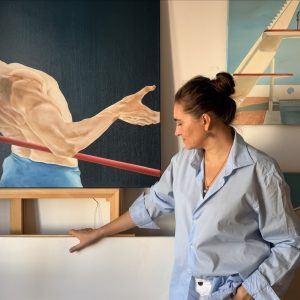
Belgrade-based painter Olesia Zyppelt captures the human form with tender care and absolute precision. Each scene freezes athletic bodies at the height of poise and tension, framed to limit our view. Her aggressively cropped compositions heighten our sense of suspense, creating intrigue in the unknown. Olesia has exhibited her work in several shows from Serbia to Switzerland.
Static, silent, and focused, discover the graceful prowess on display in the work of this month’s One to Watch.
What inspired you to become an artist?
Inspiration is not quite the right word. What made me an artist was greed: a greed for form, for light, for the ability to capture the exact tension I see in the most ordinary body movement. At forty-five, when I had to rebuild my life from scratch in a new country, I finally stopped ignoring this need and immersed myself entirely in painting, which helped me survive psychologically in a new reality.
So my work was born from an internal tension; it is not an abstract “love for the beautiful,” but a greed for visual forms, a hypersensitivity to the moment, and a refusal to compromise on how I see things. And it was never about a desire to please or cater to everyone. It is an honest, sometimes brutal exploration of my own limits.
Can you tell us a little about your artistic career so far?
The Academy of Arts in St. Petersburg gave me what I could not have started without: precise drawing, deep knowledge of anatomy, and the ability to command compositional space. This isn’t just a foundation; it is the language through which I am able to speak. Beyond that, I build my career through experimentation, because standing still is physically boring to me.
I have moved from group exhibitions in Belgrade and Switzerland to my own pop-up project in the open air—it was crucial for me to see firsthand how a large form behaves outside gallery walls when nothing restrains it. Currently, I am negotiating participation in gallery programs for 2026–2027 and preparing for a solo project at a Serbian gallery in 2027. Every time, I want more space, larger scale, and a more direct confrontation between the viewer and the figure.
What is your process for turning an idea into a finished painting?
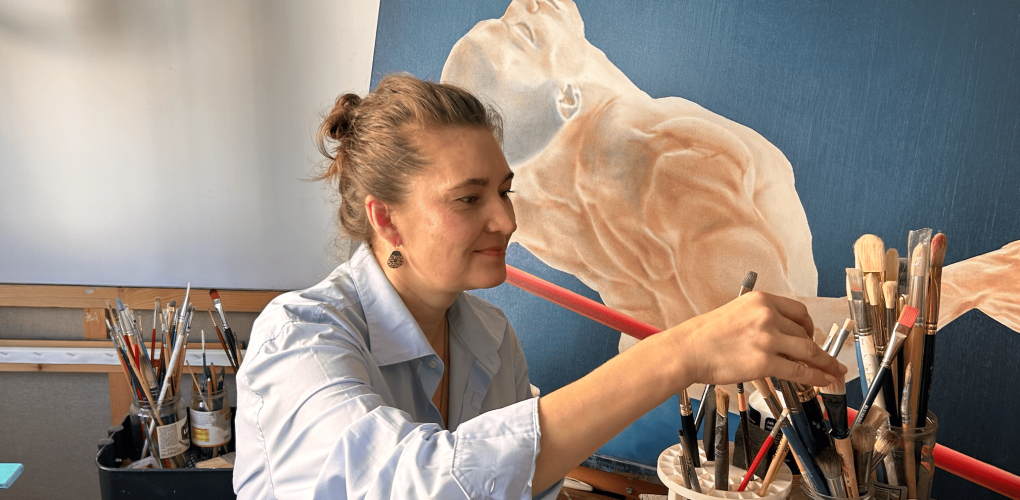
It all begins with observation, as I review numerous photo and video materials in search of that exact moment where movement and body mechanics create the necessary emotional tension. Having found that point, I move to sketches, where I boldly crop the composition and seek a complex, sharp angle, cutting away all random details to preserve only pure, resonant dynamics. On the canvas itself, the work relies on a tangible contrast of techniques.
The figure itself and the soft texture of the skin are painted in layers of oil using the dry brush technique, gradually revealing the definition of muscles and anatomy. I then juxtapose this delicate, breathing body mechanics with a dense, thick layer of oil paint in the background, where a smooth gradient highlights the silhouette and physically pushes the figure out toward the viewer.
How would you describe your style or approach to someone who hasn’t seen your work?
My style is contemporary figurative realism with a sharp, graphic character. At the center of every canvas is a human being at the exact moment tension reaches its limit: effort, balance on the edge, maximum concentration. Accurate anatomy and smooth, clean painting are key to me, so in my work, you will not find heavy texture or obvious brushstrokes, only pure form. Everything else I strip away. No unnecessary background, no distracting details. Just space with a strict geometry and a figure within it, because the focus must remain entirely on the body’s energy and its inner concentration, and on nothing else.
Are there particular themes or ideas you’re drawn to in your work?
Most of all, I am fascinated by what the body is capable of when pushed to its limit. Sports, physical exertion, and discipline are not subjects in themselves, but a way to capture the moment where maximum tension and complete inner silence exist side by side at a single point. I am interested in this exact threshold, not the outcome or the competition. I like finding the moment when the body operates at full capacity, while inside there is absolute control and clarity. The second thing that keeps me engaged is the relationship between the body and the space around it. I remove everything mundane and extraneous, leaving only pure form frozen in motion, and the feeling of a moment in which all energy is concentrated.
What advice would you give to collectors encountering your work for the first time?
I would advise looking at these works not through a search for hidden meanings, but through the perception of form and internal state. My painting—whether a dynamic figure or a focused portrait—is built on extreme concentration, body mechanics, and an honest exploration of the human condition. My main advice when viewing is to read not so much the plot, but the physical and emotional state captured on canvas. If this concentrated impulse resonates with you through the screen, then the painting has worked.
If your art could be displayed anywhere in the world, where would it be?
My dream is to present a project at Parallel Vienna in Otto Wagner’s Pavilion. I am deeply drawn to the concept of transforming the historical space of a former psychiatric clinic into exhibition halls. The stark, minimalist architecture of these walls, their light, and their context create a unique psychological atmosphere that emphasises the sharp contrast between the strict geometric environment and the intense internal concentration of the human figure on my canvases.
If your work had a soundtrack, what would it sound like?
The soundtrack to my work is “Teardrop” by Massive Attack. Its essence lies in a hypnotic bass rhythm that resembles a steady pulse. It is music of a state of mind when the physical exertion of the body is pushed to the limit, yet inside, despite the intensity, there is absolute silence and profound calm; you hear only the beating of your heart. It is precisely this contrast between external strain and inner stillness that defines my painting.
Meet more artists like Olesia. Discover a new talent or hear from your favorites in our monthly One to Watch interview.