One to Watch
 Catherine Denvir’s Strange, Storybook Paintings
Artist Catherine Denvir always wanted to paint, but life took the long way round. A childhood watching her mother draw led first to graphic design and illustration, then finally back to the canvas. Now splitting her time between London and Italy, she paints portraits steeped in memory and quiet melancholy. Here, she talks about that journey, her process, and her ideal creative collaborator.
What inspired you to become an artist?
My mother. My earliest memories are of watching her draw and marveling at it, so naturally my first and only ambition was to be an artist like my mum. I think it’s very fortunate in life when you know what you want to do. I spent many happy childhood hours drawing, making up stories, and reading.
Can you tell us a little about your artistic career so far?
Although I always wanted to paint, my art-world parents were wary of my future as a painter because they had many struggling artist friends. They encouraged me instead to study graphic design and illustration. The emphasis on abstract painting at the time also influenced my decision to study illustration and graphic design, which I did at Chelsea School of Art in London.
The course included a great deal of drawing, which has been enormously beneficial to every aspect of my career as a graphic designer, illustrator, and painter. I don’t regret having taken this meandering path towards becoming a painter. If anything, I probably enjoy and appreciate painting all the more because of it.
How would you describe your style or approach to someone who hasn’t seen your work?
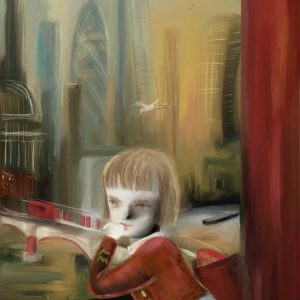
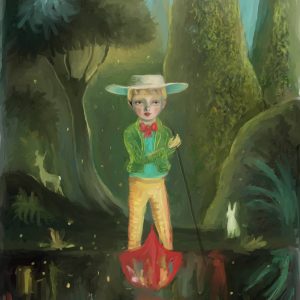
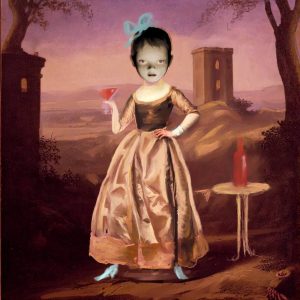
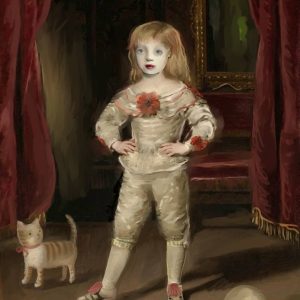
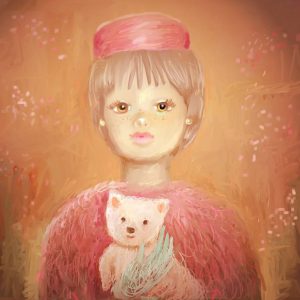
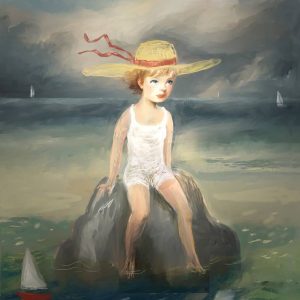
I suppose I would describe my approach to painting as an exploration of memories, impressions, and experiences. I hope all those elements come across in the work itself. I like to think of the images I make as being like stills from a film—an episode caught at a particular moment in time.
What is your process for turning an idea into a finished painting?
I always keep a note of ideas as they come to me. I message myself notes or, even better, sketch the idea down with annotations. I usually use paper—preferably a school-style squared exercise book—or a very handy app called Paper, which is like a digital Moleskine. It’s particularly good for train journeys, where I always seem to have lots of ideas, inspired by all those passing images. From there, the process of making the painting involves a lot of drawing, redrawing, discarding, and, essentially, editing.
What’s your studio like, and how does your environment influence your work?
I divide my time between London and Italy, where I am at the moment. Here I have lots of space, high ceilings, a table, an easel, good light, and distractingly beautiful views. Those surroundings certainly influence my work, although the same is true when I’m in London. Within reason, though, once I’m deeply involved in making an image, I could work almost anywhere.
How do you hope viewers respond to your work? What do you want them to
feel?
It would be nice if viewers could experience some of the mood, atmosphere, and pleasure that I felt while making the painting. However, the effect it has on them might be completely different, and that’s interesting too.
Are there particular themes or ideas you’re drawn to in your work?
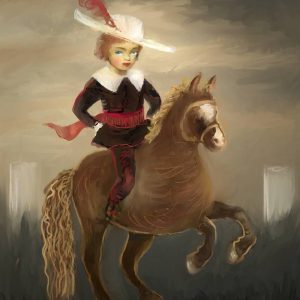
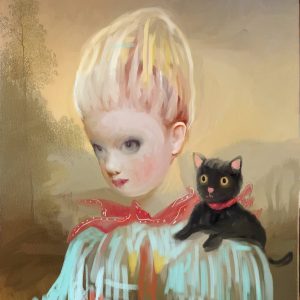
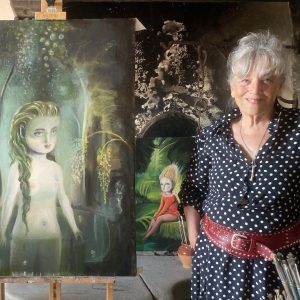
I often return to landscapes, trying to capture a sense of beautiful melancholy. Trees, forests, highways, bridges, tunnels, castles, and the marks that humans leave on nature all recur in my work. These often serve as backgrounds in which a solitary figure stands, sometimes accompanied by a horse or a cat, whose presence adds another dimension of mystery—rather like the figures in eighteenth- and nineteenth-century portrait paintings.
If you could collaborate with any artist, living or dead, who would it be?
I think I’d actually prefer to collaborate with a writer. Vladimir Nabokov would be fascinating. I’ve always seen his short stories as a series of images, and his writing has long been an inspiration to me.
If your work had a soundtrack, what would it sound like?
The soundtrack is always changing, but right now, in this hot and sultry Italian summer, it would be L’Estate by Bruno Martino.
Meet more artists like Catherine. Discover a new talent or hear from your favorites in our monthly One to Watch interview.