One to Watch
 Jonathan Monk on Restoration, Ruin, and Painting Without Fear
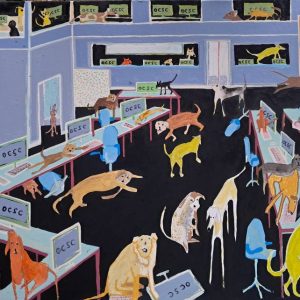
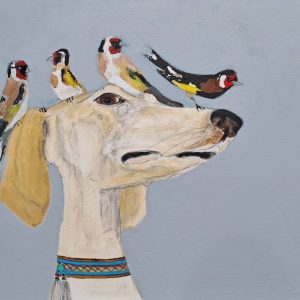
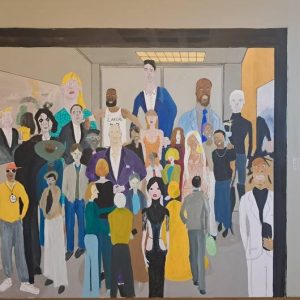
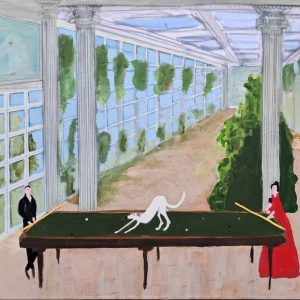
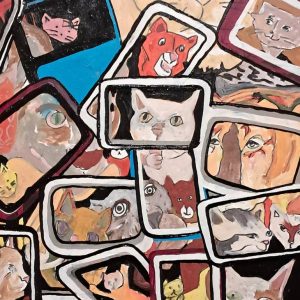
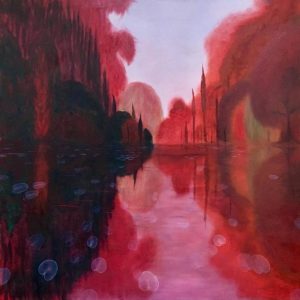
An artist and historic restoration expert, Jonathan Monk restores pre-1930s houses for a living, which means treating every surface as if it might not survive him. His canvas is where he lets his guard down. There, animals and public spaces become witty and complex social commentary, loose and funny and unbothered about being liked.
Meet him below as he talks us through the paintings, the process, and what he’s after.
Tell us about who you are and what you do. What’s your background?
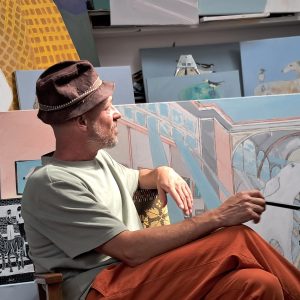
My name is Jonathan Monk. I am the founder of Jurraf, where I specialize in the authentic restoration of pre-1930s heritage residential properties, typically dated 1850-1910. In my line of work, I make attempts to restore historic properties to their ‘former glory,’ and to repair damage in the most delicate, period-appropriate, and least intrusive manner.
I previously worked as a scenic artist in theme parks and museums. Having lived abroad for many years in Morocco and Thailand, I completed artistic works before returning to the UK and retraining in Psychotherapy.
Are there particular themes or ideas you’re drawn to in your work?
I thrive on connected themes and series in my work, which grant me the freedom to seize whatever feeling takes me at a particular moment. I approach my studio. Whether my muse arises from the animal kingdom, history, or current affairs, they all contain the same base note: the theme of evolution.
Having witnessed immense societal, technological, and personal change since childhood in the 1970s, I am acutely aware of the way artistic expression evolves with the context of its appearance, and how prevalent this theme is in my body of work. I view myself as a mirror, picking up on the political, intellectual, and artistic cues which surround me. As such, change directly shapes the perspective, media, and intention which I bring to each hour of creative focus.
I hope that in the future, I can serve as an archivist: my work, a record of the climate in which I work, always with an eye to the past, the point from which evolution occurs.
What is your process for turning an idea into a finished painting?
Process is fundamental to my daily life, whether in my day job or my art, as I approach a canvas with no fear, and with either an established idea or an intense, visceral feeling. When I work, I find myself eager to reach the ‘punchline,’ the finishing strokes, the moment of satisfying completion. My experience of neurodivergence informs my reliance on a progression within my work, as I undertake epic, emotional journeys within one painting. By beginning the brushwork, underdrawing, or by simply ‘doing,’ my intent comes to the forefront.
I enjoy the feeling of cycles in my process—to some, continually developing a piece until it wholly fulfills the artist is destruction. To me, it births a foundation upon which I love to build. To be precious feels limiting, a contrast to my precise work in preservation. On the canvas, therefore, I express without constraints, and without anxiety of damaging or reducing astronomical worth.
Who are your biggest influences and why?
Lee Majors, Colt Seavers, The Fall Guy 1981: I wanted to be a stuntman. Miles Davis, be-bop, hip-hop, drum and bass, reggae. The fifteenth century artists who slightly misunderstood perspective.
Dada, Surrealism, Marcel Duchamp. A client who spent $3000 on a print.
I try not to fixate on other artists, nor other heritage businesses. What purpose does comparison serve, save to inhibit my innate creative instinct? I focus instead on authenticity, truth, and presenting every facet of my work to the world, ‘good, bad, and ugly.’ It is what it is!
How do you see your work evolving in the next few years?
I take comfort in the knowledge that I can craft any sculpture, painting, or encaustic flooring. My endeavor and inspiration needn’t be confined to a particular form or function, but is always expressed to keep me in equilibrium. The uncertainty of my future means that I see a body of work as my legacy, ideally blossoming at the ‘pinnacle’ of death! There are two clear routes which I can imagine taking: ‘gallery’ art and ‘wall’ art. Both interest me, but for different reasons. I find the notion of gallery art simpler, more comforting, and intuitive, whilst wall and commercial art require consistency, close attention, and constraint.
Thus, my future direction is comprised of a dual puzzle––both paths are valid, but would contort me in divergent ways, bringing with them unique challenges. Regardless, I know I will continue to be prolific and honest in my artistic pursuits.
How do you hope viewers respond to your works? What do you want them to feel?
I hope viewers are not limited by binaries of the ‘hive mind,’ and take the liberty to love my work, adopt neutrality, be repulsed, or any shade of feeling in between. There is always intention, though, regardless of reception. Some work, I hope, is pretty, witty, shocking, or repellent.
I am your mirror.
I want audiences to view my work with honesty above all, however that may manifest, because the best art requires bearing all and believing in the inherent value of granting attention to the interiority of another.
Do you have a favorite piece of your own artwork? Why?
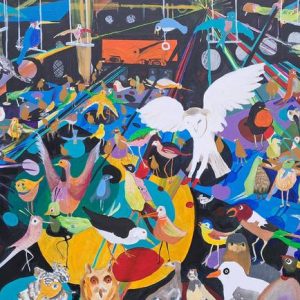
My favorite piece would be DJ Crane playing the classics at Finches, as its metaphorical dimensions of inclusion and acceptance—all species dancing under one roof—is what our world is crying out for.
If your art could be displayed anywhere in the world, where would it be?
Saatchi Gallery, London. Whilst it may seem to be the mute, predictable response, I studied when Saatchi and the surrounding Young British Artists exploded in the 1990s. In particular, I remember visiting Swiss Cottage. I think this would be my spiritual home.
Meet more artists like Jonathan. Discover a new talent or hear from your favorites in our monthly One to Watch interview.