Art News
The 2026 Art Trends
The contemporary art market doesn’t follow trends; rather, it reveals them. If you’ve been watching the art market in 2025, you’ll have noticed that the blue-chip playbook and institutional validation are becoming increasingly irrelevant as a new generation of collectors makes decisions based on emotional connection.
We’ve looked inward at Saatchi Art data and outward at the broader market to find the signals. These trends are occurring simultaneously in studios and collections worldwide, driven by artists responding to our cultural moment and collectors hungry for work that feels authentic. Discover the five shifts we’re sure to see more of in the new year.
1. Immersive Scale: Art That Commands the Room
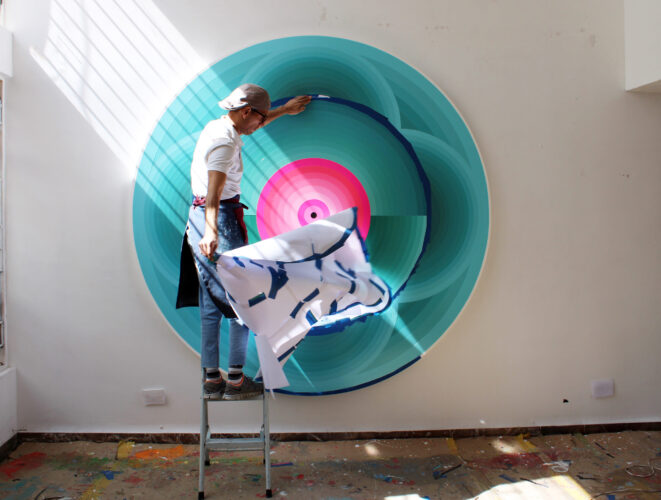 Artist Jaime Domínguez
What’s happening: Between the internet’s establishment as our third space, post-NFT craze, and current AI boom, the pendulum is swinging back to art that demands physical presence, not just your eyes on a screen.
Why it matters: After years of consuming art as content, there’s an appetite for art as environment. Art buyers are drawn to work that creates moments rather than fills gaps. Immersive-scale pieces—whether paintings, sculptures, or textiles—transform how spaces feel and function. They can be conversation starters, mood-setters, and architectural elements all at once.
What to consider buying: Oversized abstract paintings with commanding color fields; sculptural works that interact with light and space; installations that create environments rather than occupy them.
Explore Saatchi Art curators’ oversized art picks.
2. Collage and Craft: Irreplicable Artistry
What’s happening: As AI-generated imagery proliferates, collectors are gravitating toward work that foregrounds the artist’s hand. There’s a want for something that AI can’t replicate.
Why it matters: Art lovers want proof of time spent and skill honed by the artist. The intuitive decision-making of cutting paper, the texture of hand-stitched thread, and the serendipity of found materials arranged and rearranged—collage and craft-based work carry evidence of their creation. This movement signals a broader cultural shift toward valuing labor, materiality, and the imperfect.
What to consider buying: Paper collage with visible tears and layers; textile art incorporating embroidery or weaving; assemblage work using found materials; mixed-media pieces that combine painting with three-dimensional elements. Discover curator picks.
3. Dream Logic: The Surrealist Revival
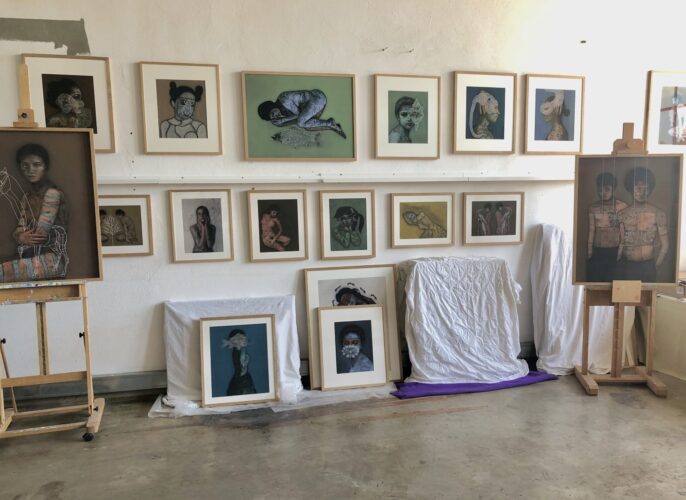 In aritst Nikki Pelaez‘s studio
What’s happening: Perhaps it’s connected to Surrealism celebrating its centenary or record-breaking sales, such as Frida Kahlo’s work fetching $54.7 million at auction, but surrealist artwork is making a comeback in mind and genre-bending ways.
Why it matters: We’re living in surreal times, and contemporary artists are processing that through surreal imagery. They’re using dream logic to process contemporary anxieties, desires, and disconnections. Collectors are responding because surrealist work operates on multiple levels. It’s visually arresting, intellectually engaging, and emotionally evocative without being obvious.
What to consider buying: Impossible compositions that feel dreamlike rather than random; biomorphic and psychological figuration; surrealist art objects.
Explore surrealist art for your collection.
4. Childlike Wonder: Sincerity Over Sophistication
What’s happening: Maximalism, kitsch, and nostalgia are everywhere. All of these trends point to a want of authentic and immediate connection. The aesthetic might vary—bold decoration or clean simplicity—but the goal remains the same: art that conveys feeling first.
Why it matters: After decades of conceptual complexity, art lovers want art that communicates directly. They’re looking for works that are joyful, accessible, and unapologetically earnest. There’s also the nostalgic element: these works often evoke childhood, folk art traditions, and a pre-digital visual language that feels increasingly precious.
What to consider buying: Drawings of simplified figures and landscapes; paintings that reference folk art, Neo-Expressionism, or illustration. Explore art that fuels childlike wonder.
5. Next Generation Artists: Emotionally Driven Collecting
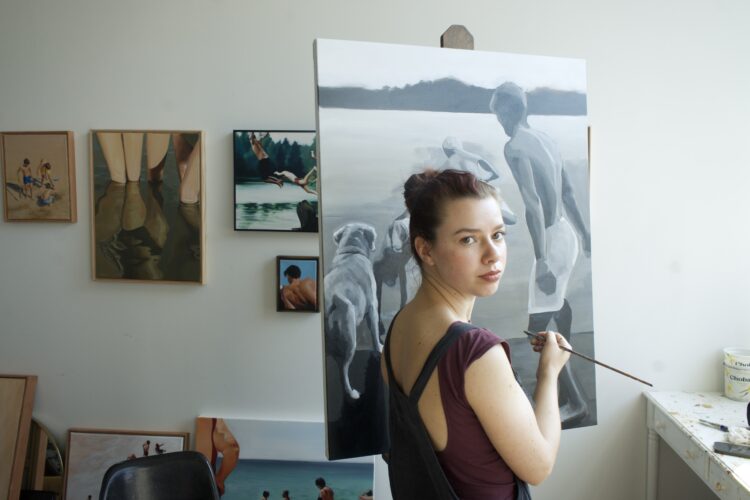 Saatchi Art artist and 2024 Rising Star Kate Keery
What’s happening: Collectors, especially those building their first serious collections, are investing directly in emerging artists whose work resonates emotionally first, even if the artist doesn’t yet have institutional validation.
Why it matters: The art market is less gatekept than ever. People have access to thousands of emerging artists through online platforms and social media. They’re making decisions based on personal connection rather than waiting for galleries or auction houses to anoint the “right” artists to collect.
This shift is creating a new definition of blue-chip. Collectors understand they’re participating in an artist’s career and helping support their path, often at the most exciting stage.
What to consider buying: Under-the-radar artists like Saatchi Art’s Rising Stars, whose works provoke an immediate emotional response. Discover curator picks.
The Through Line: Authenticity and Connection
These trends reflect a broader recalibration of the art market. For collectors or first-time buyers: 2026 is shaping up to be a year for meaning over price tags. Art is about personal connection, so this is the kind of correction that returns art buying to its essential purpose: finding work that adds meaning, beauty, and emotional resonance to daily life.